


Acute diarrhea: Difference between revisions
Ostermayer (talk | contribs) |
Ostermayer (talk | contribs) |
||
| Line 129: | Line 129: | ||
==Treatment== | ==Treatment== | ||
===Supportive Therapies=== | |||
====Oral rehydration==== | |||
#Fluids should contain sugar, salt, and water | |||
====Probiotics==== | |||
#Lactobacilli and bifidobacterium | |||
#25% decrease in average duration of diarrhea (good evidence) | |||
====Diet Modification==== | |||
#Eat: BRAT(Bananas, Rice, Applesauce and Toast) diet (no evidence) | |||
#Avoid: Caffeine (incr gastric motility), raw fruit (incr osmotic diarrhea), lactose | |||
====Bismuth subsalicylate==== | |||
*Consider when loperamide is contraindicated (high fever, dysentery) | |||
*Dose: 30 mL or 2tab q30 min for 8doses; repeat on day 2 | |||
*Caution: may cause bismuth encephalopathy in HIV patients | |||
====Diphenoxylate and atropine==== | |||
*Dose: 4mg QID x2d | |||
*2nd line agent (may cause cholinergic side effects | |||
===[[Antibiotics]] for Infectious Diarrhea=== | |||
*Most cases of diarrhea are not from infectious causes. If the patient suspects that there is blood in the stool but there is no abdominal pain, and no fever, the cause is unlikely to be from a bacterial cause. Also avoid antibiotics in E. Coli 0157:H7 (EHEC) cases due the risk of [[Hemolytic Uremic Syndrome (HUS)]]''<ref name="practical guide"> Aranda-Michel J et al. Acute diarrhea: A practical review. AmJMed. 1999;106:670-676.</ref> | |||
*The majority of patients, even with bacterial positive cultures, will recover from diarrhea illness without antibiotic therapy<ref>DuPont HL et al. Practice Parameters Committee of the American College of Gastroenterology. Guidelines on acute infectious diarrhea in adults. Am J Gastroenterol. 1997;92:1962-1975.</ref> | |||
====Relative Indications for Antibiotics<ref>IDSA Practice Guidelines for the Management of Infectious Diarrhea. 2001. [http://www.idsociety.org/uploadedFiles/IDSA/Guidelines-Patient_Care/PDF_Library/Diarrhea.pdf fulltext]</ref>==== | |||
#Suspected bacterial diarrhea | |||
#Bloody diarrhea (except for EHEC) with fever and systemic illness | |||
#Occult blood or +fecal leukocytes | |||
#Moderate to severe travelers' diarrhea (>4 stools/d, fever, blood, or mucus in stool) | |||
#>8 stools/d | |||
#Volume depletion | |||
#>1wk duration | |||
#Immunocompromised | |||
#Toxic appearance | |||
====Empiric Therapy==== | |||
{{Diarrhea Empiric Therapy}} | |||
====[[Clostridium difficile]]==== | |||
{{Severe Cdiff Antibiotics}} | |||
====[[Campylobacter jejuni]]==== | |||
{{Campylobacter antibiotics}} | |||
====[[Amebiasis|Entamoeba Histolytica]]==== | |||
{{Entamoeba diarrhea antibiotics}} | |||
====[[Giardia lamblia]]==== | |||
{{Giardia antibiotics}} | |||
====[[Microsporidium]]==== | |||
{{Microsporidium antibiotics}} | |||
====[[Cryptosporidium]]==== | |||
{{Cryptosporidium diarrhea antibiotics}} | |||
====[[Salmonella]]==== | |||
{{Salmonella diarrhea antibiotics}} | |||
====[[Shigella]]==== | |||
{{Shigella diarrhea antibiotics}} | |||
====[[Cholera|Vibrio Cholerae]]==== | |||
{{Vibrio cholerae antibiotics}} | |||
====[[Amebiasis|Yersinia enterocolitica]]==== | |||
{{Yersiniae enterocolitica antibiotics}} | |||
==Disposition== | ==Disposition== | ||
Revision as of 15:26, 15 April 2015
Background
- Almost all true diarrheal emergencies are of noninfectious origin
- 85% of diarrhea is infectious in etiology
- Viruses cause vast majority of infectious diarrhea
- Bacterial causes are responsible for most cases of severe diarrhea
- Foreign travel assoc w/ 80% probability of bacterial diarrhea (see Traveler's Diarrhea)
- Definitions
- Diarrhea: Increased frequency of defection, usually >3 bowel movements per day
- Hyperacute: 1-6 hr
- Acute: less than 3 wks in duration
- Gastroenteritis: Diarrhea with nausea and/or vomiting
- Dysentery: Diarrhea with blood/mucus/pus
- Invasive = Infectious
Diagnosis
History
- Possible food poisoning?
- Symptoms occur within 6hr
- Does it resolve (osmotic) or persist (secretory) w/ fasting?
- Are the stools of smaller volume (large intestine) or larger volume (small intestine)
- Fever or abdominal pain? (diverticulitis, gastroenteritis, IBD)
- Bloody or melenic?
- Tenesmus? (shigella)
- Malodorous? (giardia)
- Recent travel? (Traveler's Diarrhea)
- Recent Abx? (C. diff)
- HIV/immunocomp/sexual hx
- Heat intolerance and anxiety? (thyrotoxicosis)
- Paresthesias or reverse temperature sensation? (Ciguatera)
Physical Exam
- Thyroid masses
- Oral ulcers, erythema nodosum, episcleritis, anal fissure (IBD)
- Reactive arthritis (Arthritis, conjunctivitis, urethritis)
- Suggests infx w/ salmonella, shigella, campylobacter, or yersinia
- Rectal exam for fecal impaction
- Guaiac
- Abdominal pain out of proportion to exam (mesenteric ischemia)
Toxigenic v. Infectious
| Characteristic | Toxic | Infectious/Invasive |
| Incubation | 2-12h | 1-3d |
| Onset | abrupt | gradual |
| Duration | <10-24h | 1-7days |
| Fever | No | Yes |
| Abdominal Pain | Minimal | Yes, tenesmus |
| Systemic | No | Yes, myalgias, N/V |
| Physical findings | Nontoxic | Toxic |
| Abdominal Tenderness | No | Yes |
| Stool Blood, WBCs | No | Yes |
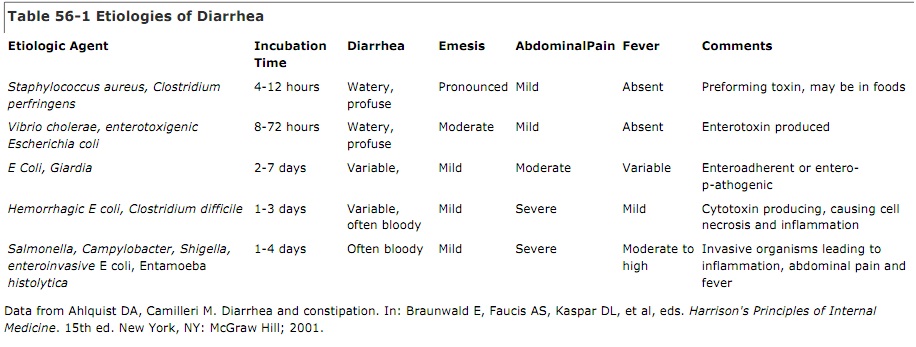
Differential Diagnosis
Acute diarrhea
Infectious
- Viral (e.g. rotavirus)
- Bacterial
- Campylobacter
- Shigella
- Salmonella (non-typhi)
- Escherichia coli
- E. coli 0157:H7
- Yersinia enterocolitica
- Vibrio cholerae
- Clostridium difficile
- Parasitic
- Toxin
Noninfectious
- GI Bleed
- Appendicitis
- Mesenteric Ischemia
- Diverticulitis
- Adrenal Crisis
- Thyroid Storm
- Toxicologic exposures
- Antibiotic or drug-associated
- Inflammatory bowel disease
Watery Diarrhea
- Enterotoxigenic E. coli (most common cause of watery diarrhea)[1]
- Norovirus (often has prominent vomiting)
- Campylobacter
- Non-typhoidal Salmonella
- Enteroaggregative E. coli (EAEC)
- Enterotoxigenic Bacteroides fragilis
Traveler's Diarrhea
- Giardia lamblia
- Cryptosporidiosis
- Entamoeba histolytica
- Cyclospora
- Clostridium perfringens
- Listeriosis
- Helminth infections
- Marine toxins
- Ciguatera
- Scombroid poisoning
- Paralytic shellfish poisoning
- Neurotoxic shellfish poisoning
- Diarrheal shellfish poisoning
Work-Up
Indicated for:
- Profuse watery diarrhea w/ signs of hypovolemia
- Severe abdominal pain
- Fever >38.5 (101.3) (suggests infection w/ invasive bacteria)
- Symptoms >2-3d
- Blood or pus in stool (E. coli 0157:H7)
- Recent hospitalization or abx use
- Elderly or immunocompromised
- Systemic illness w/ diarrhea (esp if pregnant (listeria))
Stool Studies
Fecal leukocytes
- Used to differentiate invasive from noninvasive infectious diarrheas
- Sn 50-80%, Sp 83% for presence of bacterial pathogen
- If pt has +leukocytes but negative infection consider IBD
Stool culture
- Plays minor role in ED evaluation
- Yield is only 1.5-5.5%
- Consider in pts w/:
- Immunosuppression
- Severe, inflammatory diarrhea (including bloody diarrhea)
- Underlying IBD (need to distinguish between flare and superimposed infection)
O&P
- Indicated if parasitic cause is suspected:
- Diarrhea >7d
- Untreated water
- AIDS
- Bloody diarrhea w/ few or no fecal leukocytes (intestinal amebiasis)
C. diff toxin
- 10% false negative rate
- Takes 24hr to run
Chemistry
- Warranted in severely dehydrated pts
Abdominal X-ray
- Consider if h/o abdominal sx (r/o obstruction)
Chest Xray
- Consider if diarrhea + cough (Legionella)
CT
- Consider if suspect mesenteric ischemia
Treatment
Supportive Therapies
Oral rehydration
- Fluids should contain sugar, salt, and water
Probiotics
- Lactobacilli and bifidobacterium
- 25% decrease in average duration of diarrhea (good evidence)
Diet Modification
- Eat: BRAT(Bananas, Rice, Applesauce and Toast) diet (no evidence)
- Avoid: Caffeine (incr gastric motility), raw fruit (incr osmotic diarrhea), lactose
Bismuth subsalicylate
- Consider when loperamide is contraindicated (high fever, dysentery)
- Dose: 30 mL or 2tab q30 min for 8doses; repeat on day 2
- Caution: may cause bismuth encephalopathy in HIV patients
Diphenoxylate and atropine
- Dose: 4mg QID x2d
- 2nd line agent (may cause cholinergic side effects
Antibiotics for Infectious Diarrhea
- Most cases of diarrhea are not from infectious causes. If the patient suspects that there is blood in the stool but there is no abdominal pain, and no fever, the cause is unlikely to be from a bacterial cause. Also avoid antibiotics in E. Coli 0157:H7 (EHEC) cases due the risk of Hemolytic Uremic Syndrome (HUS)[2]
- The majority of patients, even with bacterial positive cultures, will recover from diarrhea illness without antibiotic therapy[3]
Relative Indications for Antibiotics[4]
- Suspected bacterial diarrhea
- Bloody diarrhea (except for EHEC) with fever and systemic illness
- Occult blood or +fecal leukocytes
- Moderate to severe travelers' diarrhea (>4 stools/d, fever, blood, or mucus in stool)
- >8 stools/d
- Volume depletion
- >1wk duration
- Immunocompromised
- Toxic appearance
Empiric Therapy
- Ciprofloxacin 500mg PO BID x 5 days OR
- Levofloxacin 599mg PO once daily x 5 days OR
- TMP/SMX 1 DS tablet PO BID x 5 days
Clostridium difficile
- Vancomycin 125 mg PO four times daily for 10 days
- Fidaxomicin 200 mg PO two times daily for 10 days
Campylobacter jejuni
- Erythromycin 500mg PO BID x 5 days
- Ciprofloxacin 500mg PO BID x 5 days OR
- Azithromycin 500mg PO once daily x 5 days
Entamoeba Histolytica
- Metronidazole 750mg PO three times daily for 5-10 days PLUS
- Paromomycin 500mg q8hrs for 7 days OR
- Iodoquinol 650mg q 8hrs daily 20 days
Giardia lamblia
- Metronidazole 250mg PO q8hrs for 7-10days
- Tinidazole 2g PO once
Microsporidium
- Albendazole 400mg PO BID x 21 days + HAART therapy if HIV positive
Cryptosporidium
- Paromomycin 500mg PO q8hrs x 14-28days +HAART therapy if HIV positive
Salmonella
- Treatment is not recommended routinely but should be considered if:
- Immunocompromised
- Age<6 mo or >50yo
- Has any prostheses
- Valvular heart disease
- Severe Atherosclerosis
- Active Malignancy
- Uremic
Options: Immunocompromised patients should have 14 days of therapy
- TMP/SMX 1 DS tab PO BID x 5 days
- Ceftriaxone 2g IV once daily x 5 days
- Levofloxacin 500mg PO once daily x 5 days
- Ciprofloxacin 500mg PO BID x 5 days
Shigella
Treatment extended for 10 days if immunocompromised'
- Ciprofloxacin 500mg PO BID x 5 days
- TMP/SMX 1 DS tab PO BID x 5 days
- Levofloxacin 500mg PO once daily x 5 days
- Azithromycin 500mg PO daily x 5 days
Vibrio Cholerae
- Doxycycline 300mg PO as single dose
- TMP/SMX 1 tablet (5mg/kg) PO BID daily x 3 daily
- Azithromycin 20mg/kg (1g) PO once
Yersinia enterocolitica
Antibiotics are not required unless patient is immunocompromised or systemically ill
- Ciprofloxacin 500mg PO BID daily
- Levofloxacin 500mg PO once daily
- TMP/SMX 1 DS tab (5mg/kg) PO BID
Disposition
- Conservatism should be the rule with the young and the elderly
See Also
References
- ↑ Marx et al. “Cholera and Gastroenteritis caused by Noncholera Vibrio Species”. Rosen’s Emergency Medicine 8th edition vol 1 pg 1245-1246.
- ↑ Aranda-Michel J et al. Acute diarrhea: A practical review. AmJMed. 1999;106:670-676.
- ↑ DuPont HL et al. Practice Parameters Committee of the American College of Gastroenterology. Guidelines on acute infectious diarrhea in adults. Am J Gastroenterol. 1997;92:1962-1975.
- ↑ IDSA Practice Guidelines for the Management of Infectious Diarrhea. 2001. fulltext