


STEMI mimics
Revision as of 19:28, 19 September 2015 by Mhockstein (talk | contribs)
Background
- ST segment elevation (defined as 1mm in two contiguous leads or any Left Bundle Branch Block (LBBB) configuration meeting Sgarbossa criteria) should always be assumed to be a myocardial injury pattern until proven otherwise.
- When STEMI is unlikely, there are several other etiologies of ST elevation that can be considered.
- If myocardial ischemia is suspected but not (yet) evident, serial ECG’s are helpful, as only 72% of patients will receive the diagnosis of STEMI within the first 1.5 hrs (Riley et al 2013).
Mnemonic
The useful mnemonic “ELEVATION”, can help you remember some of the causes of STEMI mimics – Electrolytes, Left Bundle Branch Block, Early repolarization, (left) Ventricular hypertrophy, (ventricular) Aneurysm, Thailand (Brugada syndrome), Inflammation (pericarditis), Osborne (J) waves, and Non-ischemic vasospasm.
Electrolytes
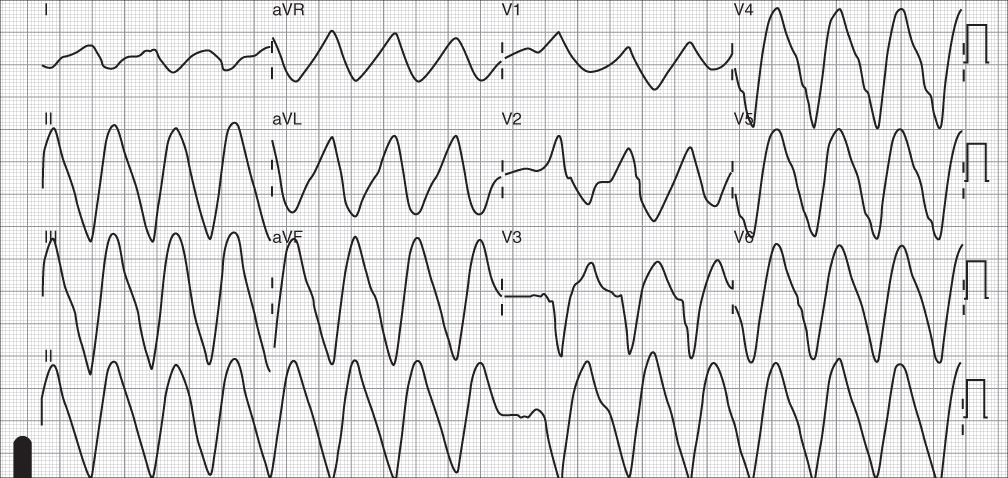
- In hyperkalemia, T waves are peaked without any concave-down (tombstone) ST elevation. The T waves of hyperkalemia should be tall, symmetrical, pointed, and narrow. Untreated hyperkalemia will progress to a sinuventricular rhythm, or a sine wave. For the treatment of hyperkalemia, please go here.
Left Bundle Branch Block
- LBBB as well as any LBBB configuration (ex: RV pacing) can result in ST segment elevation, usually < 5mm. To determine if there is a concurrent infarct in the setting of a LBBB, consider using Sgarbossa’s Criteria.
- In addition, may look for Cabrera’s sign or Chapman’s sign if infarct is suspected, though both are poorly sensitive but do add specificity.
- RBBB does not typically give ST elevation, therefore in cases of RBBB, the usual STEMI rules apply.
Early Repolarization
- This is a normal variant often seen in young athletes. The term is synonymous with J-point elevation (though not to be confused with a J-wave), i.e. elevation of the point where the QRS usually meets the isoelectric line.
- Some studies suggest an increased risk of VF in these patients, though the lifetime risk remains unclear.
Ventricular Hypertrophy (Left)
- Left Ventricular Hypertrophy (LVH), typically with ‘strain’ pattern: in these cases, the ST elevation should only be in V1-3, be concave-up (i.e. not a tombstone morphology), be discordant with the deep S wave, and not be elevated >2mm.
Aneurysm
- After an MI, the walls of the ventricles can become aneurysmal and manifest on the surface 12 lead as persistent ST elevation in the territory of the old infarct.
- Q waves (from the previous MI) should already be present in the leads with persistent ST elevation, i.e. where the infarct occurred.
- An echocardiogram is required for the final confirmation of the diagnosis of a ventricular aneurysm.
- Takotsubo cardiomyopathy (broken heart syndrome) will present similarly.
Thailand
- Brugada syndrome, a mutation in a cardiac sodium channel (mostly SCN5A), was first described in Thailand in 1992. It is thought to be responsible for 4-5% of all sudden cardiac deaths.
- There are three described electrocardiographic types. Types 1 and 2 more commonly give ST elevation while type 3 has a “saddleback” appearance without ST elevation.
- The Brugada pattern can be pharmacologically induced (ex: antiarrhythmics such as sodium channel blockers), precipitated by illness or fever, or be intermittent (will commonly see an incomplete RBBB pattern).
Inflammation
- In pericarditis, look for diffuse ST elevation. PR depression is typically only seen in viral pericarditis, though the teaching is that this is a classic electrocardiographic sign of pericarditis.
- In acute pericarditis, there might be PR elevation and ST depression in aVR only, but this is poorly sensitive.
- Consider the diagnosis of STEMI in favor of pericarditis when: there is ST depression anywhere (except for V1, aVR), ST elevation height in lead III > lead II, there is a convex/horizontal ST elevation morphology, or when there are new Q waves.
Osborn (J) wave
- Hypothermia, usually <30 C is associated with the presence of Osborn J waves.
- Osborn waves are positive deflections at the J point.
- Bradycardia (including AV block) and atrial fibrillation are also common in moderate and severe hypothermia.
- Of note, hypothermic patients are at risk for VF.
Non-Ischemic Vasospasm
- This is a true ST elevation, in the sense that the ST elevation pattern is that of an injury current, but has a different mechanism and a different management.
- Cocaine-induced ST elevation secondary to vasospasm should be treated with benzodiazepines and nitrates as needed, as it is not the result of a plaque rupture and clot formation.
- While it is possible to have a STEMI from a ruptured plaque and subsequent clot formation in a patient with cocaine toxicity, it is helpful to risk stratify patients with a suspected STEMI by age, risk-factors, etc.
- It may be impossible to tell by surface ECG (and therefore without a left heart catheterization) if the ST elevation is due to cocaine toxicity or due to plaque rupture.