


Maxillofacial trauma: Difference between revisions
No edit summary |
No edit summary |
||
| Line 60: | Line 60: | ||
==Evaluation== | ==Evaluation== | ||
<gallery mode="packed"> | |||
File:LeFort109M.jpg|thumb|A 3-D CT reconstruction showing a Le Fort type 1 fracture (marked by arrow). | |||
File:NoDisManFracMark.png|thumb|Non-displaced fracture of the mandible on CT. | |||
File:3D CT mandible fracture.jpg|thumb|3D CT reconstruction of mandible fracture, white arrow marks fracture, red arrow marks moderate displacement and open bite. | |||
File:PMC4311579 eplasty15ic05 fig1.png|thumb|CT face showing an isolated left zygomatic arch fracture impinging the coronoid of the left mandible. | |||
File:PMC3389904 poljradiol-76-1-41-g009.png|thumb|3D reconstruction of CT examination showing acute fracture of the left zygomatic arch. | |||
File:PMC4145677 eplasty14ic27 fig1.png|thumb|CT scan demonstrating a depressed zygomaticomaxillary complex fracture with loss of projection (top left), displacement at the sphenozygomatic suture (top right), zygomaticomaxillary buttress (bottom right), with minimal orbital floor displacement (bottom left). | |||
File:PMC4772575 AMS-5-262-g001.png|thumb|Left zygomaticomaxillary complex fracture with associated orbital fracture. | |||
</gallery> | |||
===Workup=== | ===Workup=== | ||
*Suspect midface fracture > facial CT | *Suspect midface fracture > facial CT | ||
Revision as of 20:00, 26 October 2021
Background
Prehospital Care
- Assess patients ability to speak and protect the airway before and frequently during transport
- Hematomas can significantly distort pharyngeal and facial anatomy making intubation or cricothyroidotomy difficult
- Increased jaw mobility from a mid face fracture may help with intubation
- Penetrating trauma to the lower third of the face frequently requires intubation or a surgical airway[1]
- Place a protective shield over an eye suspected to have a ruptured globe
- Patients should remain upright or reverse trendelenburg if there is oropharyngeal and nasal bleeding to avoid aspiration especially if placed in cervical protection
- Temporizing hemostasis with oral and nasal packing in an intubated patient may help with persistent bleeding
- Transport all avulsed pieces of the face including ears and nose
Pediatric Considerations
- Cricothyrotomy is contraindicated in patients <8yr old
- Maxillary sinuses do not develop until 6 yr old (reduces midfacial fracture)
- Pediatric orbital floor is more pliable, more likely to lead to entrapment
- Mandible fracture requires prompt referral (1-2d) due to rapid bone remodeling
Clinical Features
Ears
- Auricular Hematoma
- Signs of basilar skull fracture
- CSF leak
- Hemotympanum
- Battle Sign
Nose
- Crepitus over any facial sinus suggests sinus fracture
- Septal Hematoma
- Make sure simple nasal fracture isn't a complex naso-orbito-ethmoid injury
Oral
- Intraoral palpation of zygomatic arch to distinguish bony from soft tissue injury
- Mandible Fracture
- Place finger in auditory canal while patient opens and closes jaw to detect condyle fracture
- Tongue blade test
- 95% Sn for no fracture if can bite down hard enough to break it when twisted by examiner
- Jaw deviation due to mandible dislocation or condyle fracture
- Chin will point away from dislocation, towards a fracture
- Malocclusion occurs in mandible, zygomatic, and Le Fort fractures
- Lacerations and mucosal ecchymosis suggests mandible fracture
Other Face
- Numbness
- Check supraorbital, infraorbital, and mental nerves
- Assess Le Fort by rocking hard palate with one hand while stabilizing forehead with other
Eye
- See Orbital trauma
Visual Diagnosis


Differential Diagnosis
Maxillofacial Trauma
- Ears
- Nose
- Oral
- Other face
- Zygomatic arch fracture
- Zygomaticomaxillary (tripod) fracture
- Related
Evaluation
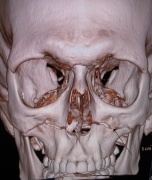
A 3-D CT reconstruction showing a Le Fort type 1 fracture (marked by arrow).
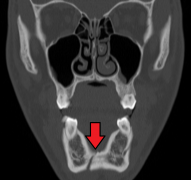
Non-displaced fracture of the mandible on CT.
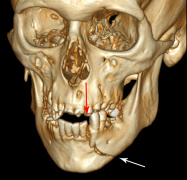
3D CT reconstruction of mandible fracture, white arrow marks fracture, red arrow marks moderate displacement and open bite.
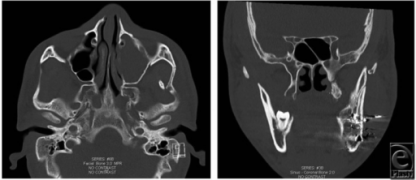
CT face showing an isolated left zygomatic arch fracture impinging the coronoid of the left mandible.
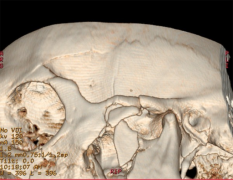
3D reconstruction of CT examination showing acute fracture of the left zygomatic arch.
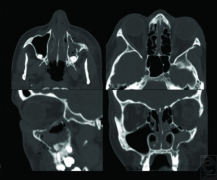
CT scan demonstrating a depressed zygomaticomaxillary complex fracture with loss of projection (top left), displacement at the sphenozygomatic suture (top right), zygomaticomaxillary buttress (bottom right), with minimal orbital floor displacement (bottom left).
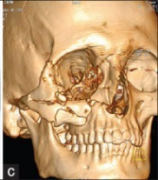
Left zygomaticomaxillary complex fracture with associated orbital fracture.


Workup
- Suspect midface fracture > facial CT
- Suspect orbital floor fracture > orbital CT
- Suspect mandibular fracture > CT face
Management
- Treat underlying process/diagnosis
Disposition
- Bedside consult is necessary for:
- Decreased vision
- Tripod Fracture
- Le Fort Fracture
- Open Mandibular Fracture
- Frontal Sinus Fractures with intracranial involvement
See Also
References
- ↑ Hollier L. et al. Facial gunshot wounds: A 4-year experience. Journal of Oral and Maxillofacial Surgery. 2011: 59:277-282